Beyond Self-Doubt and Leading with Purpose: A Twisted Melon and an Unexpected Revelation
- Vic Elizabeth Turnbull

- Jun 5
- 6 min read
When I started my professional career 20 years ago this year (which officially makes me a vintage), nobody talked about imposter syndrome.
There wasn't a collective phrase for that feeling that everyone else knew what they were doing and you felt as if you'd blagged your way into the room (as far as I knew).
No-one on LinkedIn was wanging on about it, there certainly wasn't a podcast about it and I very much doubt there was a workshop dedicated to it.
I just thought it was little old me.
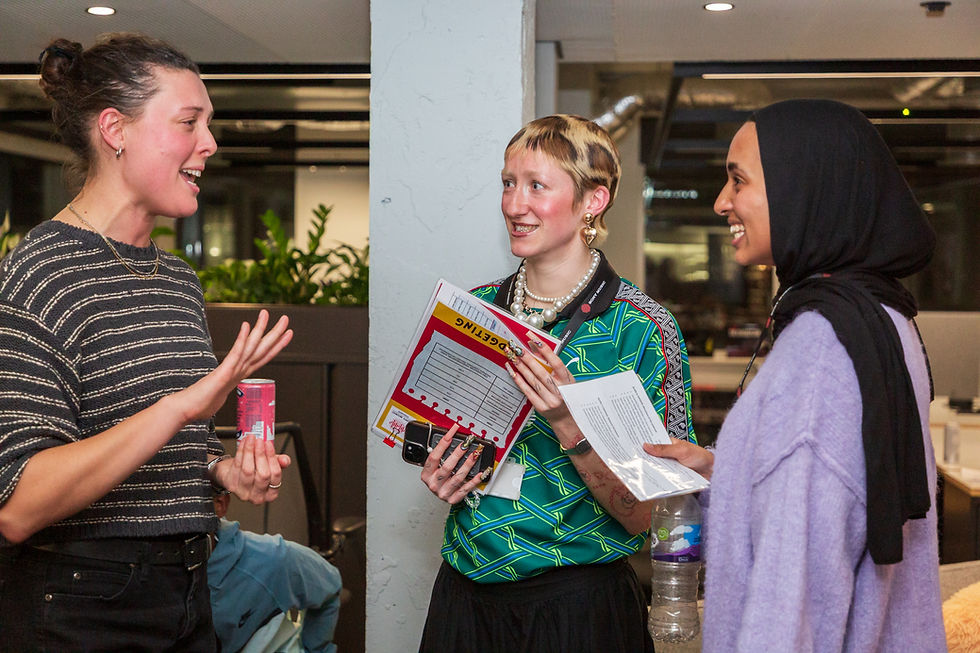
Fast forward two decades and I attended Beyond Self-Doubt and Leading with Purpose, the second leadership session in the Audio Academy's Mentoring Programme.
The programme, led by mentor, trainer and all-round cheerleader of creative careers Fran Plowright, combines six months of one-to-one mentoring with leadership sessions designed to help participants navigate the less tangible side of career progression.
This session was co-facilitated by Fran and guest facilitator Almass Badat – DJ, broadcaster, creative facilitator and multi-creative badass whose work spans music, radio, live events and cultural programming across the UK and beyond.
I thought we'd spend an afternoon talking about confidence.
Instead, I left with a revelation that completely twisted my melon (man).
And weeks later, I'm still thinking about it.
The Sesh
The session explored self-doubt, confidence, uncertainty and purpose. Or, as Fran put it, "the holistic side of career progression".
It's the stuff we don't often talk or even think about while we're busy worrying about deadlines, budgets, commissions and trying to keep all the plates (and bowls) spinning.
We explored the patterns that trigger self-doubt, the stories we tell ourselves, the gap between perception and evidence, and the practical antidotes people use when those inevitable wobbles show up.
What I didn't expect was that one conversation would completely change how I think about my own relationship with imposter syndrome.

The Bit That Twisted My Melon
One of the first exercises involved reading feedback from our mentors.
Now, that sounds nice enough on paper, but in actual real life it got a bit totes emoshe.
When we were handed our envelopes, the room filled with nervous laughter. Then as we opened our notes, there were smiles, audible ‘awwwwws’ and people re-reading bits of paper because we couldn't quite believe what they were seeing.
There’s something powerful about having positive feedback written down in black and white. It reminded me of flicking through my faux-leather burgundy Record of Achievement at school and thinking, "Oh my god, check me out, the headteacher thinks I’m alright."
What struck me though was how many people were surprised by things their mentors had written (me included!). Not because the feedback was bad, quite the opposite. But because somebody else had spotted strengths they weren't necessarily giving themselves credit for.
That theme came up again and again throughout the session → perception versus evidence.

A few weeks before the session I'd spoken at an industry event. I'd prepared like an absolute menace. I knew my material, my stories and exactly who I was talking to.
The session itself went really well. People laughed, engaged and came over afterwards to say nice things.
And still I walked away convinced I'd done a crap job.
A few days later I watched the session back.
Dear reader, it was absolutely fine.
More than fine, actually. I was kinda brill.
That's the interesting bit, though isn’t it? All the evidence pointed one way, yet my perception had sauntered off in a completely different direction.
Later in the session I got chatting to another participant and found myself trying to explain where this thing sits for me.
And this is where the clouds parted and the big revelation light shone down on my face.
Deep down, I know I've done some ace things. I've built a business from scratch, worked with brilliant people and created things I'm proper proud of.
I've somehow survived twenty years of professional life without being escorted from the building by security carrying a cardboard box and a sad office plant!

So the story isn't really that I don't think I'm good enough.
The more it chewed with my head, the more I realised it feels double-layered.
Of course I have moments of self-doubt. I overthink things, I question myself and I wonder what on earth I'm doing (thank-you anxiety).
But underneath that, there’s something slightly different.
It’s a discomfort with fully owning my achievements.
A reluctance to say, out loud, "Actually, I'm pretty good at this pal."
And then it hit me like a wet fish slap across the face.
Maybe I'm not worried about not being good enough.
Maybe I'm worried about looking like I think I'm good.
Which feels completely ridiculous when I write it down, but in the spirit of being vulnerable…there it is.
Somewhere along the way I've managed to connect confidence with showing off.
Maybe we're dimming our light in exchange for being terribly British.

The Answer Was Stuck To The Window
Another exercise was identifying the patterns that trigger our self-doubt. Before long, the windows overlooking a very sunny London skyline were covered in colourful Post-it notes.
There were worries about starting new projects, joining new teams, feeling like you're winging it, managing bigger responsibilities, not knowing the answer in a meeting, wondering whether you've chosen the right path and comparing yourself to other people.
I was nodding along to loads of them.
But the thing that connected more for me wasn't what was written down. It was who wrote them.
Everyone in that room is doing brilliant work.

And yet there we all were, admitting that every now and then our dickhead brains like to tell us otherwise.
There was something weirdly reassuring about that. Not because misery loves company, but because it was a reminder that these moments don't suddenly disappear once you've reached a certain point in your career. They just change shape.
Later in the session we moved on to the antidotes. Another collection of Post-it notes, this time filled with the positive things people tell themselves when those moments show up.
“Remember your previous feedback”
“Talk to someone”
“Think about what you'd tell a friend”
“I've done this before”
“People don't think about you as much as you think they do”
The thing is right, none of these ideas were particularly revolutionary.
There wasn't a secret recipe for ‘imposter syndrome’ success hidden in the Post-it notes.
Yet as the session wrapped up, people were photographing them, scribbling them down and trying to take a little bit of that collective wisdom home with them.
Stick a ring light on it, call it a mastermind and I bet somewhere somebody is charging £600 a seat for exactly the same advice.
But that's not really what people were taking away. The magic wasn't in the Post-it notes, it was in the room.
A room full of fabulous, experienced people saying, "I've felt that too," and sharing what they'd learned along the way.
Everyone reminding each other that self-doubt, uncertainty and the occasional confidence wobble aren't signs that you're failing, they're signs that you're human.
It wasn’t theory, it was lived experience.
And that carries a lot more weight than any LinkedIn guru ever could.

So What Am I Taking Away?
I've found myself thinking about this session quite a lot since getting back from London.
Mostly because of that revelation that completely twisted my melon. For years, I'd assumed imposter syndrome was simply about thinking you're not good enough.
Now I'm not too sure.
Maybe for some of us it's not about lacking confidence at all.
Maybe it's about being uncomfortable with confidence.
Maybe it's about being so keen not to sound arrogant that we end up talking ourselves down instead.
I don't know if I've completely figured it out yet. Twenty years in, I still have plenty of "who am I and what the fuck am I doing?" moments, and I suspect they'll continue popping up.
What I do know is that I'll probably be a little quicker to challenge them when they do.
Because maybe the goal isn't to get rid of self-doubt altogether.
Maybe it's to recognise when your brain is telling you a story that simply isn't true.
And if all else fails, I'll return to the final slide of the day.
Have some fucking confidence in what you're doing.
Easier said than done, of course.
But probably worth a fair shot.


Comments